The management accountant as cloud herder Part 1
Technological change has impacted and shaped society for ages – from the first use of a tool to the first abacus up to steam power and the computer. That is nothing new, and I have yet to find the person to contest it.
Hand in hand with technological change came the craving to codify information generated – arguably, the quicker the technological change, the more information generated. That means information about EVERYTHING. One of the main drivers was undoubtedly IT and computer technology, but only since the world wide web became fast and affordable to the masses (and businesses), the flow of newly generated information and data is mind-blowing. According to Nick Bontis from McMaster University in Hamilton, Canada, everything we know and wrote down on a stone, papyrus or in a Word document – or as he calls it “cumulative codified information base” doubled every 30 years when evaluated in the 1930s, every 7 years in the 1970s, in the future we can expect that everything we know and wrote down doubles every 11 hours (Bontis, 2011). Even from our own experience as part of the world wide web, email and social media we can tell that we have no way of keeping up even with everything that lies in the sub-set of “interesting to me”.
Now it is safe to say that businesses have always produced massive amounts of data, from ledgers in the 15th century to customer data used and employed by the likes of Google, Amazon or Facebook. Data from transactions, patterns in customer behaviour, market reactions, costs and prices – it goes on and on. The assumption is thus not far-fetched that businesses as part of our culture and society are at least not slower in codifying new information.
To managers, that information is key to decisions they need to make on various bases, from daily, short-term to strategic, long-term ones. In order to do this – and so we learn and teach and assume – the management accountant is the role that is responsible in order to gather, process and provide this decision-relevant information to the managers. Looking in any textbook, however modern, shows that this is still the basic assumption what the management accountant is and does.
(Continued in part 2)
Technological progress 2
Following from our last post, have a look at this:

I came across it on a social network. If you are a student, you may be too young to remember when Internet speeds were 64Kb per second or so – yes that’s Kb not Mb per second. Nowadays 40-50 Mb is normal at home and in business. That’s nearly 1000 times faster.
Technological progress
Here’s are very simple graphic which shows how technology has progressed in 9 years.
Mainframes 50 years old and still in use
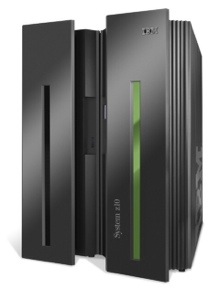
In Chapter 1 of our book, there is a brief history of computing. The mainframe computer is 50 years old and this BBC feature gives a brief summary of their history. And as the article notes, they are still in use today.
iXBRL in action – Ireland’s Revenue Commissioners
Image reisgtered to XBRL.org
From late 2013, most larger Irish companies have to file their financial statements in iXBRL format. As you learned in Chapter 7 of our textbook, iXBRL is an embedded form of XBRL. The Revenue Commissioners – Ireland’s tax authority – provide lots of useful information on iXBRL at this link. It is worth having a read through these pages as it brings Chapter 7 to life.
Excel tips – INDEX and MATCH
Here is a link to a very useful exercise on the Excel INDEX and MATCH functions. These functions are useful for looking up data in spreadsheets.
Inbound interfaces – an example from SAP
As you might imagine, any business that starts using a system like SAP will most likely want to transfer data from their old system. This might be anything from customer details, to open invoices on customer/supplier accounts, to closing ledger balances. Transferring can be done two ways, manually to using an interface.
Ultimately, using an interface is probably best as it automates mundane work and is likely to be less error prone than manual entry. For example, can you imagine and organisation with 2,000 customers, each with 5 outstanding invoices? That’s 10,000 entries to be made manually – not an ideal scenario. So an interface would be the best option, but what is an interface?
In this case, we can describe an interface as an agreed format to transfer data from one system to another. SAP for example uses a concept call iDocs to not only transfer data within SAP, but also receive data from outside. You can think of an iDoc as a simple text file, with lines of text. The first line is a control record, with each line thereafter a data record. In simple terms, the control record tells the system where the data which follows is to go. Each record (line) in the iDoc is 1,000 characters long, and the position of each character determines what the data means – the positions are defined by SAP. Here is an example of what an iDoc record might look like:
ORDERHEADER 1088 1089 12500.50 24121998 Micky Mouse
Normally, a programmer develops some programme code which can extract data from the sending system to comply with iDoc format. Then, when the programme is run, the iDoc is read by SAP and the relevant data fields are populated e.g. customer details, open invoices.
Keeping data secure
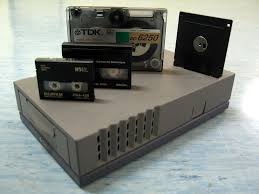
Image from wikipedia
It is good practice to keep a backup copy of key business data. Basis practice is to take a backup of key organisational data regularly on a medium that can be stored offsite if necessary. Arguably, in a cloud computer environment a backup is not needed, but many organisations still (and probably always will) maintain some data internally.
One quite old method of storing a backup copy of data – or even storing data – is on magnetic tape. As recently noted in the Economist, this backup medium has gained a new lease of life. Cloud storage has become so cheap and fast, that the tape could have been seen as redundant. But one thing a magnetic tape has is portability – it can thus be easily secured anywhere, away from normal business risks or even hackers. As noted in the Economist article, many organisations also now generate huge volumes of data (i.e. big data) which may be useful for analysis. Tapes can easily store such data.
The article also notes four advantages tapes have as a backup medium:
1- data can be retrieved fast
2- power is not needed to store the data
3- there are secure as mentioned
4- they can be repaired (spliced).
There are also likely to be improvements in tape technology in coming years as their value for storing large amounts of data has come back into vogue.
Technology must have business benefits
A production manager I once worked said to me “you have to show me the business benefits of that new thing”. He was referring to a new information system function the company wanted to implement. I have since always tried to remember this. We probably all want the latest and greatest piece of technology, but what benefits will it bring us. And in a business, we also want benefits – lower costs, more efficient processes for example.
Here is a short story which I hope shows you how even the smallest business can use technology top deliver business benefits. Where I live, we have a milk delivery man. Recently, he left a leaflet at my door about a new initiative called mymilkman.ie. I can’t think of a more traditional business than doorstep milk delivery, so you can image my curiosity – I had to ask what the benefits are for the milkman. So, I duly asked our milkman. He said the system allows customers to pay using a debit or credit card, and this has saved one milkman he knows about 10 hours per week – even though only 50% of customers signed up. Normally, customers would pay by cash and this implies calling at a separate time than the normal delivery time. Add to the time-saved the costs saved in lower fuel and it seems like a big benefit to any milkman.
The system has been created by several Irish dairies, and no doubt there is a business benefit for them too – probably something like more accurate demand forecasting, better cash-flow and so on.

 Business information systems for accounting students