Home » Articles posted by martinjquinn (Page 3)
Author Archives: martinjquinn
Keeping data secure
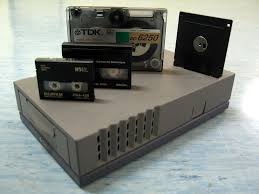
Image from wikipedia
It is good practice to keep a backup copy of key business data. Basis practice is to take a backup of key organisational data regularly on a medium that can be stored offsite if necessary. Arguably, in a cloud computer environment a backup is not needed, but many organisations still (and probably always will) maintain some data internally.
One quite old method of storing a backup copy of data – or even storing data – is on magnetic tape. As recently noted in the Economist, this backup medium has gained a new lease of life. Cloud storage has become so cheap and fast, that the tape could have been seen as redundant. But one thing a magnetic tape has is portability – it can thus be easily secured anywhere, away from normal business risks or even hackers. As noted in the Economist article, many organisations also now generate huge volumes of data (i.e. big data) which may be useful for analysis. Tapes can easily store such data.
The article also notes four advantages tapes have as a backup medium:
1- data can be retrieved fast
2- power is not needed to store the data
3- there are secure as mentioned
4- they can be repaired (spliced).
There are also likely to be improvements in tape technology in coming years as their value for storing large amounts of data has come back into vogue.
Technology must have business benefits
A production manager I once worked said to me “you have to show me the business benefits of that new thing”. He was referring to a new information system function the company wanted to implement. I have since always tried to remember this. We probably all want the latest and greatest piece of technology, but what benefits will it bring us. And in a business, we also want benefits – lower costs, more efficient processes for example.
Here is a short story which I hope shows you how even the smallest business can use technology top deliver business benefits. Where I live, we have a milk delivery man. Recently, he left a leaflet at my door about a new initiative called mymilkman.ie. I can’t think of a more traditional business than doorstep milk delivery, so you can image my curiosity – I had to ask what the benefits are for the milkman. So, I duly asked our milkman. He said the system allows customers to pay using a debit or credit card, and this has saved one milkman he knows about 10 hours per week – even though only 50% of customers signed up. Normally, customers would pay by cash and this implies calling at a separate time than the normal delivery time. Add to the time-saved the costs saved in lower fuel and it seems like a big benefit to any milkman.
The system has been created by several Irish dairies, and no doubt there is a business benefit for them too – probably something like more accurate demand forecasting, better cash-flow and so on.

Book publication
Our book will be published in April 2014. We will be writing regular blog posts from then. For now, here is the Table of Contents of the book.
Part 1
INTRODUCTION TO INFORMATION SYSTEMS, DESIGN AND IMPLEMENTATION
1 Introduction to information systems and accounting
2 Information systems and technology – some basic terminology and concepts
3 The role and development of information systems and technology in accounting
4 Accounting information systems change and development
Part 2
ACCOUNTING INFORMATION SYSTEMS IN LARGER ORGANISATIONS
5 Enterprise Systems
6 Integrating information systems
7 Extensible Business Reporting Language (XBRL)
Part 3
ACCOUNTING INFORMATION SYSTEMS IN SMALLER ORGANISATIONS
8 Accounting software for smaller businesses
9 Software-as-a-service
10 Decision support with spreadsheet software
 Business information systems for accounting students